Catfishing
Catfishing is when someone creates a fake online identity to build trust or a relationship, often to manipulate the other person for money, gifts, or personal information, even if it starts friendly or romantic.
What Is Catfishing?
Catfishing is a type of social engineering in which someone, often a scammer, creates a fake online identity to build trust, form a relationship, or manipulate another person—often for emotional, financial, or personal gain. Catfishers may use stolen photos, invented life details, or completely fabricated profiles to mislead others into believing they’re someone real.
Catfishing isn’t just about “tweaking a dating profile.” It can involve months or even years of deceptive interaction that exploits peoples' vulnerabilities like loneliness or trust.
In the FBI’s 2024 IC3 Annual Report, Confidence/Romance scams, in which catfishing tactics are often used, accounted for nearly 18,000 complaints and almost $700 million in reported losses, underscoring the serious financial impact of catfishing-related fraud.
What Catfishing Looks Like in Real Life

Catfishing often starts on social media, dating apps, or messaging platforms. The person may seem attentive, kind, and eager to connect, but they avoid meeting in person or making video calls. Over time, the relationship may become emotionally intense, making requests for help or money feel harder to question.
Common Examples of Catfishing-related Scams
Catfishing is frequently linked to long-term relationship scams, including:
- Romance scams where a fake partner asks for financial help
- Military romance scams claiming deployment or emergencies abroad
- Online dating investment scams encouraging you to move conversations off the platform
Who Scammers Typically Target
Catfishers don’t pick victims at random. Reports show that certain groups are disproportionately targeted or affected:
- Online daters: Many catfishing scams begin on dating apps and social platforms. In one recent report, roughly 40% of online daters said they’d been targeted by a scam on these platforms.
- Young adults: People in their late teens through their 30s are frequently targeted due to high activity on social media and dating apps.
- Middle-aged and older adults: While younger users are often contacted more frequently, people ages 40–69 report high rates of confidence fraud, and older adults often suffer larger financial losses.
- Single, divorced, or widowed individuals: Scammers often exploit emotional vulnerability during major life transitions, especially when people are seeking connection or companionship.
That said, catfishing isn’t limited to these groups. Fake profiles have been used to target teenagers, professionals, and even public figures, showing that while scammers focus on certain audiences, anyone can be exposed.
How Catfishing Entered Popular Culture

The idea of catfishing became widely understood thanks to media portrayals that brought the term into the mainstream:
- “Catfish” (2010 Documentary): This documentary follows filmmaker Nev Schulman as he discovers the person he’s been corresponding with online isn’t who she claimed to be. The film helped popularize the term “catfish” to describe online imposters.
- MTV’s :Catfish: The TV Show Premiering in 2012, this reality series expands on the concept by investigating real cases of online deception—sometimes leading to emotional confrontations or surprising reveals.
- Manti Te’o Catfishing Hoax: One of the most infamous real-world cases involved former Notre Dame and NFL linebacker Manti Te’o, who was led to believe he was in a long-distance romance with a woman who didn’t actually exist. The story made national headlines and later became the subject of the Netflix documentary Untold: The Girlfriend Who Didn’t Exist.
How Catfishing Causes Harm
Catfishing scams can cause serious emotional distress as well as significant financial loss. Because these schemes often unfold gradually, people may become deeply invested before realizing something is wrong.
According to the Federal Trade Commission and the FBI, romance-related scams tend to result in higher median financial losses than many other forms of consumer fraud, largely because scammers build trust and emotional dependence before ever asking for money.
How to Protect Yourself From Catfishing
Catfishing scams rely on emotional manipulation, urgency, and secrecy. These steps can help you spot red flags early—before a relationship or conversation escalates.
Slow things down
Be cautious of online relationships that become intense very quickly. Excessive flattery, constant messaging, or early declarations of love—often called love bombing—are common tactics used to build trust fast.
Be skeptical of avoidance tactics
Repeated excuses to avoid video calls or in-person meetings—such as overseas work, military deployment, or personal emergencies—are common warning signs of a fake identity.
Watch what you share online
Oversharing personal details like your relationship status, recent losses, health issues, or travel plans can make it easier for someone to tailor believable stories and build false emotional connections.
Verify profiles and images
Fake or stolen photos, limited social media history, or inconsistencies in age, job, or location can indicate a fabricated identity. AI-generated images and polished bios are increasingly common.
Get a second opinion
Catfishers often encourage secrecy. Talking with a trusted friend or family member can help surface red flags you might miss when emotions are involved.
Check suspicious messages before responding
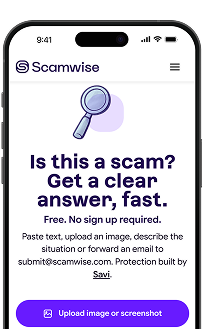
If you’re unsure about a message, call, or email, use a trusted free scam checker like Scamwise to review it before engaging.
FAQs
What is catfishing?
Catfishing is when someone uses a fake online identity to build trust or a relationship, often for manipulation or fraud.
Is catfishing always a scam?
Not always, but it becomes a scam when the fake identity is used to request money, gifts, or personal information.
What should I do if I think I’m being catfished?
Stop sharing personal information, avoid sending money, and consider ending communication. If financial details were shared, contact your bank and report the incident to the FTC (https://reportfraud.ftc.gov) or the FBI (https://www.ic3.gov).
You can't always be there. Savi can.